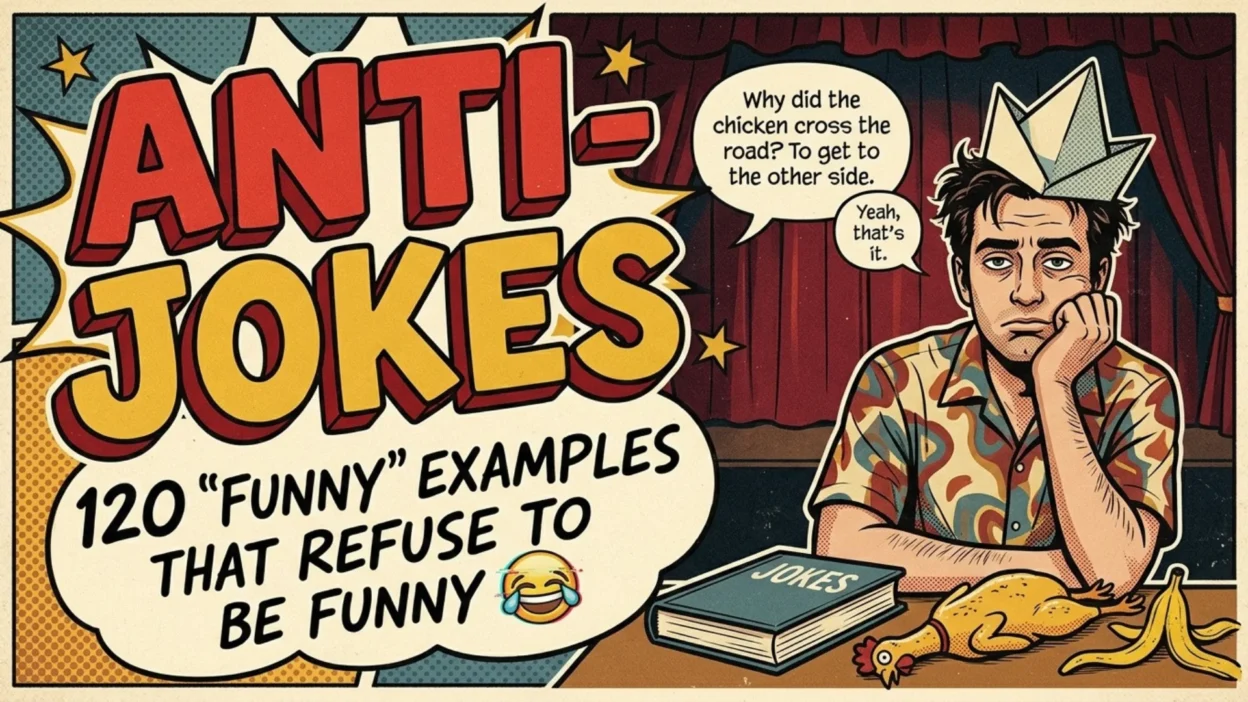
Anti jokes are for people who enjoy humor that takes the most unexpected route: the obvious one. Instead of ending with a clever pun or a surprising twist, an anti joke delivers a plain, honest, or almost painfully logical answer. That is the entire point. You expect a punchline, but the joke gives you a completely ordinary response.
For example, why did the chicken cross the road? To get to the other side. There is no hidden meaning, secret trick, or elaborate explanation. The answer is exactly what it sounds like, and that simplicity creates the humor.
This collection of anti jokes includes short one-liners, school jokes, work jokes, animal jokes, and plenty of wonderfully awkward answers. They are easy to share with friends, add to group chats, or tell at family gatherings. Some might make everyone laugh, while others may earn nothing more than a long, confused stare. Either way, that reaction is part of the fun.
What Are Anti Jokes? 🤔
Anti jokes are jokes that deliberately avoid the clever punchline people expect. Traditional jokes often rely on wordplay, exaggeration, or an unexpected connection. Anti jokes take the opposite approach. They set up a familiar question and then answer it with something literal, ordinary, or completely reasonable.
For example:
- Why did the student bring a notebook? To write things down.
- What do you call a dog that is sleeping? A sleeping dog.
- Why did the man open the window? He wanted fresh air.
- What happened when the clock stopped? It stopped telling the time.
- Why did the woman buy groceries? She needed food.
These examples are funny because they refuse to make an ordinary situation more complicated than it needs to be. The listener expects a clever ending, but the answer is almost disappointingly sensible.
Anti jokes also differ from ordinary bad jokes. A bad joke may try to be funny and fail. An anti joke intentionally avoids the usual punchline. That difference makes the awkward silence, rather than a clever word, the source of amusement.
1. Classic Anti Jokes That Keep Things Simple 😂
Sometimes, the simplest answer is the best answer. These classic-style anti jokes use familiar setups and deliberately obvious endings.
- Why did the chicken cross the road? 🐔 To get to the other side.
- Why did the man sit down? 🪑 Because he was tired of standing.
- What did one wall say to the other wall? 🧱 Nothing. Walls cannot talk.
- Why did the woman turn on the light? 💡 The room was dark.
- What do you call a cow with no legs? 🐄 A cow that cannot stand.
- Why did the boy open the refrigerator? 🧊 He wanted to see what was inside.
- Why did the person cross the street again? 🚶 They needed to return to the other side.
The trick is to deliver these jokes as if the answers are genuinely surprising. Avoid adding explanations afterward. Once the listener realizes that the joke has no clever ending, the silence can do the rest of the work.
2. Short Anti Jokes for Quick Laughs ⚡
Not every joke needs a long introduction. Short anti jokes work especially well in text messages, comments, and casual conversations. Their quick delivery makes the ordinary answer even more unexpected.
- What is blue and smells like blue paint? 🎨 Blue paint.
- Why did I buy a calendar? 📅 I needed to know the dates.
- What did the banana say? 🍌 Nothing. Bananas cannot speak.
- Why did the computer turn off? 💻 Someone switched it off.
- What do you call a person with no name? 🪪 A person whose name you do not know.
- Why did the glass break? 🥛 It fell onto a hard surface.
- What happened to the unfinished joke? ✏️ It remained unfinished.
These are ideal when a conversation needs a little silliness without a long story. If you enjoy extremely simple humor, you might also like these corny jokes, which use a more traditional style of silly comedy.
3. Funny Anti Jokes About School 🎒
School provides endless material for jokes because students and teachers spend their days doing familiar things. These examples take ordinary classroom moments and answer questions with complete seriousness.
- Why did the student study for the exam? 📚 The student wanted to prepare.
- Why did the teacher erase the board? 🧽 The board had writing on it.
- What did the math book say to the student? ➗ Nothing. It was a book.
- Why did the student bring a pencil? ✏️ The teacher asked everyone to bring one.
- Why was the classroom noisy? 🗣️ Several students were talking.
- Why did the school bell ring? 🔔 Its scheduled ringing time arrived.
- What did the student get for answering a question correctly? 📝 The answer was marked correct.
School anti jokes work because the questions sound as though they should lead to a clever explanation. Instead, each answer gives the kind of information anyone could have guessed. The more seriously these jokes are delivered, the better the effect.
4. Work and Office Anti Jokes 💼
Office life is full of meetings, emails, deadlines, and coffee breaks. These anti jokes turn those familiar experiences into humor by refusing to exaggerate them.
- Why did the employee arrive at work? 🏢 The employee had a job.
- Why did the manager schedule a meeting? 📅 The manager wanted people to meet.
- What did the computer do during the meeting? 💻 It remained on the desk.
- Why did the worker send an email? 📧 The worker wanted to communicate in writing.
- Why did the employee take a lunch break? 🥪 It was time to eat lunch.
- What happened when the printer ran out of paper? 🖨️ It could not print on paper that was not there.
- Why did the worker look at the clock? ⏰ The worker wanted to know the time.
These jokes are particularly effective around coworkers who understand everyday office routines. For a different kind of workplace humor, explore teacher jokes, which focus on classroom life and the people who work in education.
5. Animal Anti Jokes for Everyone 🐶
Animals already have plenty of personality, but anti jokes do not need to give them human conversations or elaborate adventures. Sometimes, an animal is simply doing what animals do.
- Why did the dog bark? 🐕 It made a barking sound.
- What did the cat say to the dog? 🐈 Nothing. The cat did not speak.
- Why did the bird fly away? 🐦 It flew somewhere else.
- What do you call a fish that swims? 🐟 A fish.
- Why did the horse eat grass? 🐴 It was hungry and grass was available.
- What did the duck do at the pond? 🦆 It was at the pond.
- Why did the rabbit hop? 🐇 Hopping is one way rabbits move.
Animal jokes are easy to share with children because the setups are familiar and the answers are simple. If animal humor is a favorite, check out these duck jokes for more quacking fun, including jokes that use traditional puns.
6. Food Anti Jokes That Leave You Hungry 🍕
Food jokes often depend on clever names, silly comparisons, or unexpected wordplay. Anti jokes skip those tricks and focus on what happens when people prepare, eat, or buy food.
- Why did the person eat breakfast? 🍳 The person was hungry in the morning.
- What did the sandwich say to the plate? 🥪 Nothing. Sandwiches cannot talk.
- Why did the pizza go into the oven? 🍕 It needed to be baked.
- What do you call a cold cup of tea? ☕ A cup of tea that is cold.
- Why did the baker make bread? 🍞 Making bread was part of the baker’s job.
- What happened when the cookie was eaten? 🍪 Someone ate the cookie.
- Why did the person open a bag of chips? 🥔 The person wanted some chips.
The fun comes from how little these answers reveal. There is no secret ingredient and no surprise recipe. If you prefer food jokes with more wordplay, our collection of pizza jokes offers another flavor of comedy.
7. Technology Anti Jokes for the Digital Age 📱
Modern life gives us phones, laptops, chargers, and apps. Yet even the most advanced technology can inspire a joke that goes absolutely nowhere.
- Why did the phone ring? 📱 Someone called it.
- What did the laptop say to the charger? 🔌 Nothing. It was an electronic device.
- Why did the Wi-Fi stop working? 🌐 The connection was unavailable.
- What happened when the battery reached zero? 🔋 The device ran out of battery power.
- Why did the person restart the computer? 💻 The person wanted to restart it.
- What did the printer print? 🖨️ Whatever was sent to it, assuming it worked.
- Why did the person take a screenshot? 📸 The person wanted to save an image of the screen.
Technology jokes work particularly well in group chats because everyone has experienced a device refusing to cooperate. The humor becomes even drier when the speaker treats an obvious technical problem as an extraordinary discovery.
8. Relationship Anti Jokes That Are Painfully Honest 💌
Romantic comedy usually relies on grand gestures, dramatic misunderstandings, and clever declarations. Anti jokes take a more direct approach. These examples are playful, gentle, and suitable for sharing with a partner or friend.
- Why did the couple go to dinner? 🍽️ They wanted to eat together.
- What did one partner say to the other? 💬 Something that the other partner could hear.
- Why did the person buy flowers? 💐 The person wanted to give someone flowers.
- Why did the couple take a photograph? 📷 They wanted a picture of themselves.
- What is the secret to a long conversation? 🗣️ Both people keep talking or listening.
- Why did someone send a goodnight message? 🌙 It was nighttime, and they wanted to say goodnight.
- Why did the couple watch a movie? 🎬 They wanted to watch a movie.
These jokes work best when everyone understands that the humor is intentionally dry. For a more flirtatious style, browse our funny pickup lines and compare their clever punchlines with the complete lack of wordplay in anti jokes.
9. Family-Friendly Anti Jokes for Kids 👨👩👧👦
A good children’s joke does not need complicated vocabulary or an elaborate story. These clean anti jokes use familiar situations and answers that young listeners can understand easily.
- Why did the child put on shoes? 👟 The child wanted to wear shoes.
- What did the teddy bear do at bedtime? 🧸 It stayed wherever someone put it.
- Why did the child drink water? 💧 The child was thirsty.
- What happens when you water a plant? 🌱 You give the plant water.
- Why did the child open a storybook? 📖 The child wanted to read it.
- Why did the ball roll down the hill? ⚽ The ball moved downhill.
- What did the toy car say? 🚗 Nothing. It was a toy car.
Parents and teachers can use these examples to introduce children to different styles of humor. Ask children to predict a clever answer first, then reveal the obvious one. The contrast helps them understand why the jokes are deliberately different from ordinary riddles.
For more gentle family humor, take a look at our best dad jokes ever. Those jokes usually offer a recognizable punchline, making them a fun contrast to the anti jokes above.
10. Everyday Life Anti Jokes 🏠
Ordinary routines are excellent material for anti humor. Getting dressed, washing dishes, shopping, and checking the weather all become unexpectedly amusing when the answer is as straightforward as possible.
- Why did the person wash the dishes? 🍽️ The dishes were dirty.
- Why did the man carry an umbrella? ☔ He expected rain.
- What happened when the alarm went off? ⏰ The alarm made a sound.
- Why did the woman lock the door? 🔑 She wanted the door locked.
- Why did the person go shopping? 🛒 The person needed to buy something.
- What did the washing machine wash? 🧺 The clothes placed inside it.
- Why did the person sit on the sofa? 🛋️ It was a place to sit.
Everyday anti jokes can make ordinary conversations feel a little ridiculous. They also work well as social media captions because they are short and easy to understand without additional context.
11. Deadpan Anti Jokes With Awkward Endings 😐
Deadpan humor depends on a straight face and a calm delivery. The speaker does not signal that the joke is coming. Instead, the answer sounds like a serious statement, even when the setup suggests something more exciting.
- Why did the man enter the building? 🚪 He walked through the entrance.
- What happens when you drop a spoon? 🥄 It falls if nothing catches it.
- Why did the person check the mirror? 🪞 The person wanted to see their reflection.
- What did the clock do at midnight? 🕛 It showed the time.
- Why did the runner stop running? 🏃 The runner stopped moving at a run.
- What happened when the book closed? 📕 The covers came together.
- Why did the person turn off the television? 📺 The person no longer wanted it on.
To make these jokes land, resist the urge to smile too early. Deliver the answer calmly, then pause. That brief moment when the listener realizes there is no hidden punchline often creates the biggest reaction.
12. One-Line Anti Jokes for Texts and Group Chats 💬
Need something short to send a friend? These one-line anti jokes fit neatly into messages, comments, or captions. They are simple enough to understand at a glance and deliberately too literal to be traditional punchlines.
- I bought a pencil. ✏️ It was a pencil.
- My plant grew. 🌿 It grew because plants can grow.
- I made a sandwich. 🥪 Then I had a sandwich.
- My alarm rang. ⏰ I heard the alarm.
- I opened the fridge. 🧊 The fridge opened.
- I went outside. 🌤️ I was no longer inside.
- I cleaned my room. 🧹 My room became cleaner.
- I took a nap. 😴 I slept for a while.
The key to a successful one-liner is restraint. Do not add an extra sentence explaining why the joke is funny. Let the obvious answer stand on its own, and let your audience decide whether to laugh or simply move on.
Why Are Anti Jokes Funny? 🧠
Anti jokes are funny because they challenge the expectations people bring to a familiar joke format. When someone asks a question such as “Why did the chicken cross the road?” listeners usually expect a clever answer. A completely literal response breaks that expectation.
There are several reasons this style can work:
- Unexpected simplicity: The answer is much more ordinary than expected.
- Broken expectations: The setup suggests a punchline, but the answer refuses to provide one.
- Deadpan delivery: A serious tone makes an obvious answer seem even more ridiculous.
- Shared understanding: Listeners recognize the usual joke format and notice how it has been subverted.
- Awkward silence: Sometimes, the lack of a satisfying punchline becomes the memorable part.
However, anti humor does not work for everyone. Some people prefer wordplay and clever twists, while others enjoy dry, awkward comedy. The audience and delivery matter just as much as the words themselves.
How to Tell an Anti Joke Properly 🎤
Anti jokes are easy to remember, but delivering them well takes a little practice. The goal is not to make the answer complicated. Instead, the goal is to make a plain answer sound like the most natural response in the world.
Try these simple techniques:
- Keep a straight face. Avoid laughing before the answer is finished.
- Use a familiar setup. A recognizable question creates the right expectation.
- Give a literal answer. Choose something obvious instead of inventing a clever pun.
- Pause briefly. Let the audience process the anticlimax.
- Do not explain the joke. Explaining the obvious answer usually weakens the effect.
- Read the room. Choose clean, gentle humor for children or formal settings.
- Keep it short. Long explanations can make a deliberately simple joke feel confusing.
For example, ask, “Why did the person bring a chair?” Then answer, “Because they needed somewhere to sit.” Deliver it with complete seriousness. The humor comes from the fact that the answer is entirely reasonable and not clever at all.
You can also create your own anti jokes by taking a familiar riddle and replacing its expected punchline with a factual answer. Think about common activities, everyday objects, or simple cause-and-effect situations. The more ordinary the answer, the more it can contrast with the setup.
Frequently Asked Questions About Anti Jokes
1. What is an anti joke?
An anti joke is a joke that deliberately avoids a traditional punchline. Instead, it gives an obvious, literal, or ordinary answer. The humor comes from the difference between what the listener expects and what the speaker actually says.
2. What is the most famous anti joke?
“Why did the chicken cross the road? To get to the other side” is one of the best-known examples. Its answer is completely literal rather than clever, making it a classic illustration of anti humor.
3. Are anti jokes suitable for kids?
Yes, many anti jokes are suitable for children because they use simple questions and harmless answers. Examples about school, animals, food, and everyday activities are easy to understand. As with any humor, choose jokes that fit the child’s age and comfort level.
Conclusion: Enjoy the Humor of Anti Jokes 😄
Anti jokes prove that comedy does not always need a clever pun, a surprising twist, or an elaborate story. Sometimes, the funniest response is the most obvious one. That is what makes these jokes so memorable: they build an expectation and then calmly refuse to meet it.
From classroom questions to animal antics and everyday situations, these examples offer plenty of ways to share a little dry humor. Try telling one with a straight face, pause after the answer, and see how your friends react. You may get laughter, a groan, or a wonderfully confused expression.
If you want to explore the broader idea behind this style, read more about anti-humor and how it challenges traditional comedy. Then share your favorite anti joke with someone who appreciates a joke that refuses to be a joke.